
In the 16th and 17th centuries, stories circulated in Europe about Tamburlaine the Great, a little-known ruler who had reigned around 1390 and who had crushed the Turkish sultan. It concerned Timur the Crippled (1336-1405), a Mongol ruler who subjugated a large part of the Islamic world in the second half of the 14th century, but about whom not much was known in Europe – not even that Timur himself was Muslim been.
However, the story of the defeat and capture of the Turkish sultan Bajazet or Bajezid was told over and over again. Tamburlaine the Great is said to have defeated Sultan Bajazet with the largest army ever in the bloodiest battle ever and then imprisoned him in an iron cage. The mercilessly cruel ruler of humble origins is said to have continually humiliated the sultan, using him as a crutch to mount his horse, until Bajazet died.
Not only was this legend often told to explain how shaky earthly power and how quickly you could lose all your wealth, but it was also a beloved story because during this time many Europeans felt threatened by the mighty Turkish empire. Bajazet’s defeat was one of the few times the Turks had been defeated and it had taken half a century for them to become a strong threat again.
The story was also known in the Netherlands. Why the grower of this tulip decided to give his new flower the name ‘Den Grooten Tamberlaan’ is unknown – perhaps the grower was familiar with the Turkish tulips and thought that his new tulip beat those tulips from the country of the great enemy .
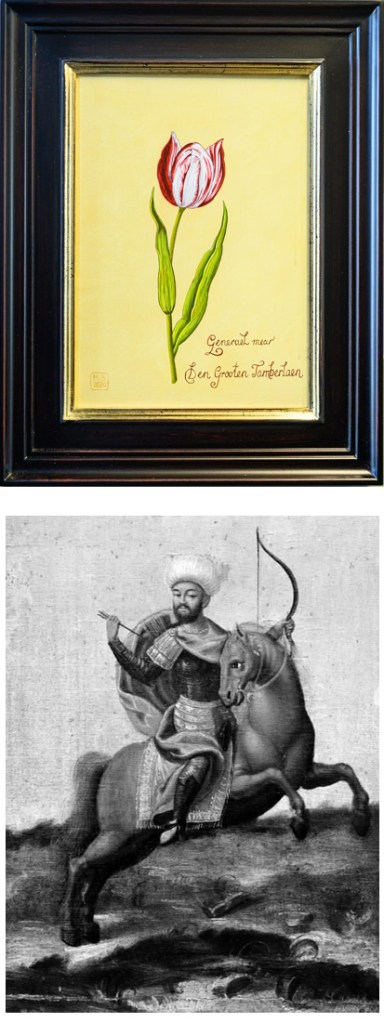
Van Baaren, M.C. (2020). Tamberlaan, (25×35 cm). Tulip Experience Amsterdam, Noordwijkerhout.
Text: Henk Looijesteijn, researcher social history at IISG Amsterdam
Literatuur:
Thomas C. Izard, ‘The Principal Source for Marlowe’s Tamburlaine’, Modern Language Notes 58.6 (1943), 411-417.
Petri Messiae, De Verscheydene lessen (Amsterdam 1617), 277-285.
Marcus Milwright, ‘So despicable a vessel: representation of Tamerlane in printed books of the sixteenth and seventeenth centuries’, Muqarnas 23 (2006), 317-344.
Marcus Milwright & Evanthia Baboula, ‘Bayezid’s Cage: a re-examination of a venerable academic controversy’, Journal of the Asiatic Society, 3rd series 21.3 (2011), 239-260.
 Ninetynine Tulips
