
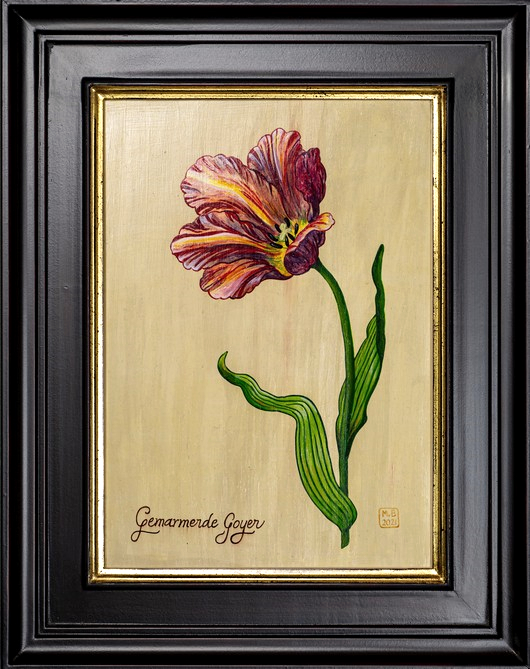
In the era of the 17th-century tulip mania, a remarkable tulip was known as the “Gemarmerde Goijer” or “Marbled Goijer”.
This tulip featured a color palette of purple, red, and yellow stripes. The unique marbled appearance was due to the presence of the tulip-breaking virus.
During the times of the Tulipmania, virus-infected tulips were highly valued, as they gave the tulip an exotic and attractive look. The marbled shades were reminiscent of luxurious, expensive marble stone, which symbolized wealth and refined taste.
The second part is derived from the bulb grower, Abraham de Goyer or Goijer (1579/80-1653) who owned a large garden complex near Amsterdam and grew numerous tulips. Several variants were to his name and he traded numerous tulips. Traders like him dominated the tulip trade. During the tulip fever he earned so well that he was able to buy a country house.
The name “Goijer” refers to the region of ‘Het Gooi’, located near Amsterdam. During the Golden Age, this area was a popular destination for the wealthy to escape the city’s hustle and bustle. It was a place where the elite retreated to their country estates, surrounded by the natural beauty of the landscape.
The “Gemarmerde Goijer” thus reflects a piece of this history. The tulip symbolizes the wealth and desire for luxury of that time, as well as the appreciation for natural beauty, even if it was inadvertently caused by a virus.
For the “Gemarmerde Goijer”, the theme of the 99 NFT tulips, in various art styles, is ‘marble’. The portrait of the “Gemarmerde Goijer” from the ‘Ninetynine Tulips’ collection serves as inspiration for the tulip NFTs.
 Ninetynine Tulips