
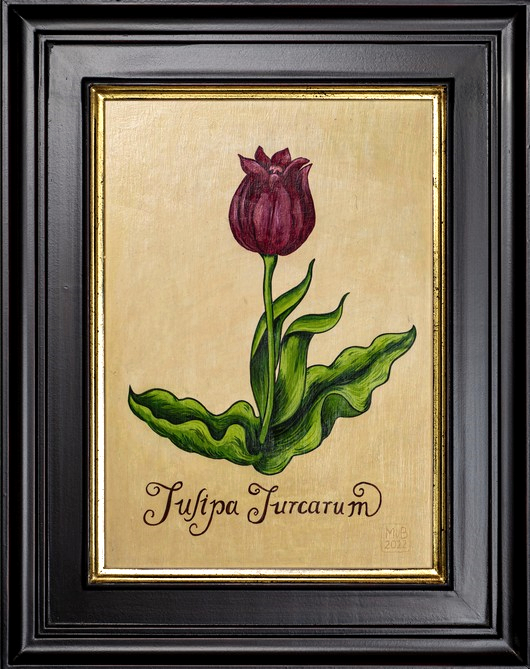
The tulip “Tulipa Turcarum” holds a significant historical value as the first tulip to be scientifically described in European botanical literature.
The name “Turcarum” refers to the Turkish origin of the tulip, from the then Ottoman Empire.
Conrad Gesner, a Swiss naturalist, philologist, and physician, provided this tulip with its scientific description around the year 1561. He was the first to mention the tulip after observing it in a garden in Augsburg, Germany. The description of “Tulipa Turcarum” also included an engraving of the tulip, making it one of the earliest depicted tulips in Europe.
This piece of historical context sheds light on how the tulip was regarded in Europe during the 16th and 17th centuries: as an exotic and valuable flower. It also marks the beginning of its rise in popularity, ultimately culminating in the frenzy of the Dutch Tulipmania in the 17th century.
This NFT, created in several art styles, serves as not only a tribute to the botanical history of the tulip but also to the cultural exchange and influence of the Ottoman Empire on Europe. The theme of the NFT is, therefore, ‘the Ottoman Empire’.
The portrait of the “Tulipa Turcarum”, from the ‘Ninetynine Tulips’ collection, serves as the inspiration for the tulip NFT collections. The theme of the 99 “Tulipa Turcarum” NFT tulips is the ‘Ottoman Empire’ after its Turkish roots.
 Ninetynine Tulips