
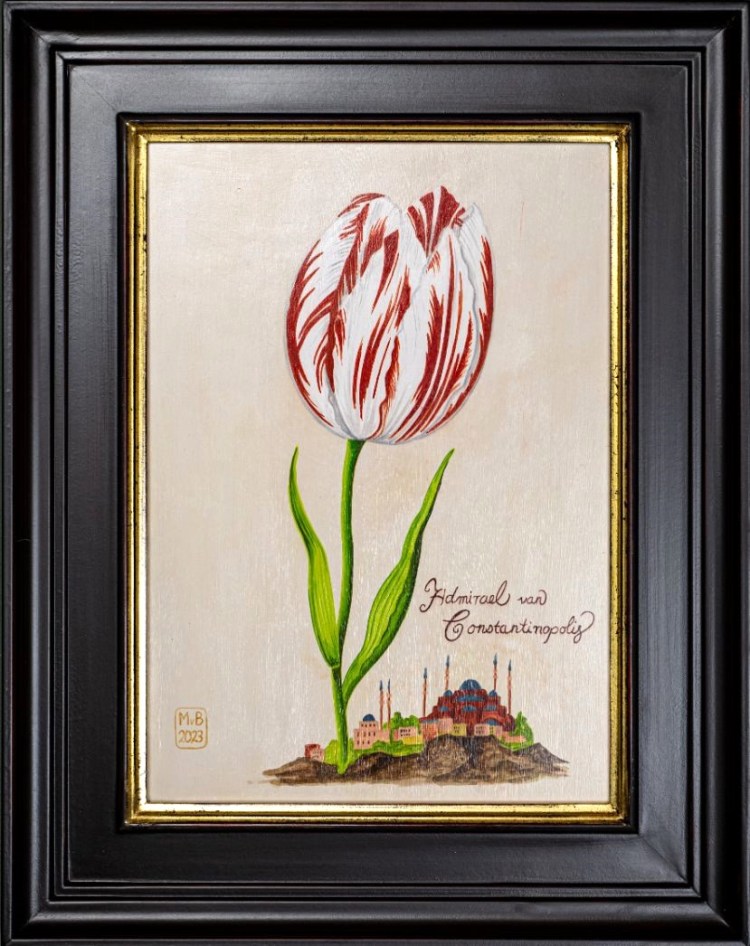
The “Admirael van Constantinopolis” honors the historical origins of the tulip.
Although the Netherlands is often associated with the tulip, this flower also has deep roots in Turkey, where the tulip was cultivated during the Ottoman Empire.
The tulip itself originates from the Pamir Mountains and was introduced to Europe via Constantinople, modern-day Istanbul.
The tulip, with its lush flower shape reminiscent of a turban, a headdress closely associated with Middle Eastern cultures, visually reinforces its eastern origins. At the base of the tulip is depicted the Hagia Sophia, an iconic landmark in Istanbul. This artistic addition emphasizes the cultural journey the tulip has made from East to West.
The Hagia Sophia, originally built as a cathedral in Constantinople (now Istanbul) in the 6th century under the direction of the Byzantine Emperor Justinian I, has served as a mosque, a museum, and is currently a mosque again, renowned for its massive dome, rich history, and architectural significance as a masterpiece of Byzantine architecture.
The 99 NFT’s in different art styles for the “Admirael van Constantinopolis” have the theme ‘Hagia Sophia’. The portrait of the “Admirael van Constantinopolis” from the ‘Ninetynine Tulips’ collection, serves as inspiration for the NFTs.
 Ninetynine Tulips